Our History Created by Aliens

They are created humans on the earth by changing the DNA Structer of the Apes

This Image Explains You How Humans Created

They Created us for their research

Alien Race On Humans

Gods Are Aliens

Monday, 6 July 2015

"Eye of The Earth" Created by Extraterrestrials?

ALIENS TAKE OVER SAHARA DESERT


This prominent circular feature in the Sahara desert of Mauritania has attracted attention since the earliest space missions because it forms a conspicuous bull's-eye in the otherwise rather featureless expanse of the desert. Described by some as looking like an outsized fossil in the desert, the structure, which has a diameter of almost 30 miles, has become a landmark for shuttle crews. Initially interpreted as a meteorite impact structure because of its high degree of circularity, it is now thought to be merely a symmetrical uplift that has been laid bare by erosion. Paleozoic quartzites form the resistant beds outlining the structure.

Image Credit: NASA/GSFC/MITI/ERSDAC/JAROS, and U.S./Japan ASTER Science Team 

Photos from outer space confirm that aliens have taken over The Sahara Desert.
A mysterious portion of the Sahara Dessert has been referred to as  The Richat Structure ( “Earth‘s bull’s eye”) for many years.  After a careful analysis by Extraterrestrial Experts from around the globe, it is now confirmed that aliens from Planet Zeeba have taken a vast area of the Sahara.
The Richat Structure is a nearly 30-mile across rock formation which is described as “somewhat mysterious” and “hypnotic”.  It was recently photographed  from the International Space Station and extraterrestrial experts from the United Nations have been analyzing the data and the photos.
“It’s definitely the work of the Zeebans.  The aliens from Planet Zeeba are peaceful aliens and it is easy to see from these formations that they are harmonious beings and are to help Earthlings,” said Dr. John Malley of the U.N. Panel on Extraterrestrials.
the structure, located in west-central Mauritania in West Africa was once thought to be an impact crater,  but its “flat middle and lack of shock-altered rock indicates that it was made by alien beings.
NASA, at first thought, that it was  ”caused by uplifted rock sculpted by erosion,” but the perfect circular formations strongly indicate that they were made by alien beings.
“Zeebans, to be specific,” said Dr. John Malley.
Many in Africa are now headed to The Richat Structure.  They feel that it could be a new start for human beings on Earth.  WWN is sending two of our reporters to the Sahara to examine it first hand.


That image is simply amazing, but now imagine seeing an eye on the surface of the Earth that is looking back at you.
This is what Astronauts see when they are looking down from space at the Richat Structure, an amazing add to the strange place collection.
The Richat Structure is a prominent circular feature  in the middle of the Sahara Desert of West-Central Mauritania. It is deeply eroded, and stretches 40 km in diameter.
Scientists originally thought it was a crater formed by a meteorite, but this was ruled out. The flat middle and lack of shock altered rock made it obvious to scientists that a rock from space did not form this structure.
Its perfectly circular shape is still a mystery today.

Advocates of the EU model claim that:
” craters like the Richat were not formed by impacts but were “machined” by electric discharges, Birkeland currents that rotate around a “sticking” point and excavate material by electrically accelerating it upwards without disturbing the surrounding or underlying strata, unless the whole area is raised in a fulgamite blister–hence Rampart Craters. Specific effects will depend on a wide variety of soil conditions including chemical composition, material type, density, moisture, and conductivity.  Discharge factors, including diameter, voltage, current, and duration will also affect the crater configuration.”
 All of these claims  sound nice and fancy, but what if it was all false?
What if this was the work of some being from a different planet?
Some alien believers have come to the conclusion that this “dome” was created by extraterrestrials as a target  for when they want to attack or land on Earth.
There is a theory that this “bulls-eye” was lasered into the Earth by aliens from another strange place.
The richat structure strange place
The Richat Structure resembles an eye
Astronauts have made it clear that it is the most visible part of Earths surface from space, and it has the most perfectly circular shape out of any landmass on Earth.
Sounds like a pretty nice target to me.

So since there are no definite facts about the creation of the Richat Structure, why not take all theories into consideration?

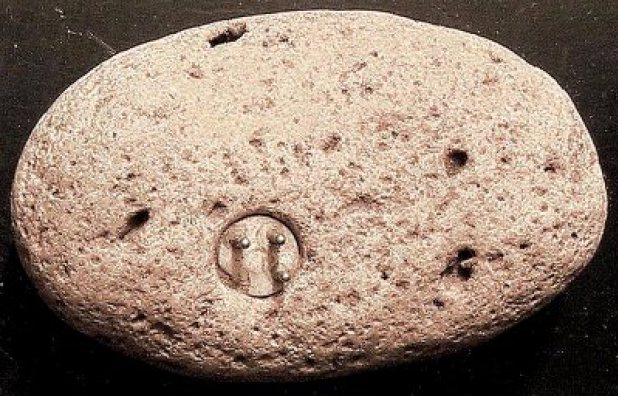
The Enigmalith: A 100,000 year old electrical component found embedded in stone

According to researchers who have analyzed the artifact, it is a 100,000 year old electrical component embedded in stone

It is one of the artifacts that a few have heard of, yet its characteristics are incredibly interesting. There have been dozens of objects discovered through the years that do not fit into the mainstream view of history, archaeology and anthropology.

This discovery was made in 1998 when electrical engineer John. J. Williams found what appeared to be an electrical connector protruding form the ground in a hiking trip in North America. The object was found in the middle of nowhere, far way from human settlements, industrial complexes, airports, factories and electronic or nuclear plants. After digging further into the ground, Williams discovered a device with a triple plug, embedded into the rock.
Williams refused to give away the exact location where the object was found, which has led skeptics to conclude that this artifact is just another hoax. But is it?
Today the artifact is referred to as the Petradox, a device that has the undeniable aspect of an electrical component which ended up embedded into solid granite, stone composed of quartz and feldspar, with small traces of mica. There is a huge amount of secrecy surrounding the object. Williams has received offers up to 500,000 dollars for the device but has refused to sell it. Williams stated that the artifact however, is available to any researchers for analysis. So far, only a few individuals have taken time to study the mysterious object, resembling without a doubt, an electrical component.
The Petradox is not an accretion, concretion, pumice or a fossil. It does not contain any known resins, cements, glues, adhesives, limestone, mortar, or other non-rhyolite / non-granite binding agents. It is very hard.
The component itself is about 8 mm in diameter; the pins of the device are about 3 mm high, and the spacing between the pins is approximately 2.5 mm while the pin thickness is about 1 mm.
According to Williams, who has consulted an engineer and geologist to examine the object, the electronic component embedded in the granite reveals no trace of having been glued or welded in any known form, it is clear that the object already existed at the time of the formation of the rock. According to geological analysis, researchers believe that the “rock” is at least 100,000 years old, something impossible if you believe that the object is of artificial origin. Conventional understanding of technological development of mankind tells us that there is no way humans could have made something like this at that time in history.
The device has been compared by some researchers to an electronic XLR connector or similar component. The artifact has a weak magnetic attraction, Ohmmeter readings indicate either open-circuit or very high impedance between the pins. The artifact does not seem to be made out of wood, plastic, metal, rubber, or any other recognizable material. Williams has not allowed the object to be broken in half for analysis but X-ray tests have shown that the artifact has a mysterious “opaque internal structure” in the center of the stone.
According to Williams, melted blobs of a metallic-like material on the component’s periphery indicate that some metal object near the Petradox was subjected to such high temperatures to cause metal melting and molten metal splashing or sputtering onto the embedded component.
Skeptics firmly believe that this 100,000 year old electrical component is a manufactured hoax, but Williams does not agree. He is convinced that he has found a genuine artifact that belonged to an advanced ancient civilization or an extraterrestrial race. Williams is willing to let researchers authenticate the artifact under certain conditions: that he is present during the analysis and that the rock remains unharmed.
rockcomponent3-2
There are some of us who believe that science does not have interest in these object because they are afraid of what they might find out. The artifact has two possibilities. While scientific analysis could confirm it as being an elaborate hoax, it could also radically change our understanding of the history of mankind and change the way we look at history and our origins.
In 1998, electrical engineer John J. Williams discovered what looked like an electrical connector sticking up out of the ground. He began digging and found that that the three-pronged plug was embedded in a small rock.
According to Williams, the curious stone was unearthed during an excursion in a rural location in North America, far from human settlements, industrial complexes, airports, factories, and electronic or nuclear plants. While it may hurt the credibility of his discovery, Williams refuses to give the exact location of his find, for fear that the site might be plundered of other mysterious relics.
Known as the “Enigmalith” (a combination of the words enigma and monolith) or” Petradox,” the device presents the undeniable appearance of an electronic component embedded in a naturally formed, solid granite stone composed of quartz and feldspar (including very small percentages of mica.)
Due to the secrecy surrounding the find, its $500,000 price tag, and an extraterrestrial theory surrounding the object, many from the scientific community have categorized the Enigmalith as a hoax manufactured solely for the fame and fortune for its owner.
However, Williams explains that his unusual stone is available to any researcher for analysis. Scientists have so far shied away from testing the rock, despite the open invitation.

Friday, 3 July 2015

Life on Mars – the evidence mounts

Methane plumes of unknown origin and carbon-based molecules in sandstone rocks have recently been detected on Mars. Both findings add weight to the case that Mars could once and may still support life.  Elizabeth Finkel reports.
A view from the Curiosity mast camera shows the dramatic buttes and layers on the lower flank of Mount Sharp in the middle of Gale crater. The different layers of exposed rocks are revealing the planet’s geological history.
Ever since 1877 when Italian astronomer Giovanni Schiaparelli pointed his telescope at the red planet and saw channels, Earthlings have been titillated by the possibility of life on Mars. The NASA missions of the ’60s and ’70s dispelled those notions. Definitely no canals; not even a trace of liquid water. Even the geology appeared dead, with its gigantic but long-silent volcanoes.
But since 2004, better instruments and wide-ranging rovers on Mars’ missions have started painting a different picture. There was once abundant flowing water, and ice still exists in pockets at the poles – and possibly elsewhere. The latest findings from the Curiosity rover reported on 16 December at the meeting of the American Geophysical Union in San Francisco, upped the ante. The planet emits mysterious whiffs of methane, a result published online in Science the same day. Considering most methane on Earth is produced by microbes, this tantalising finding was widely aired by the world’s media. Less reported was a second result, soon to be published in the Journal of Geophysical Research. Curiosity unearthed evidence of complex mixtures of carbon-based (organic) molecules in sandstone rocks.
Neither the methane nor the organic molecules in the rock are evidence of life. They could have come from interstellar dust particles or been carried aboard meteorites, and some methane was probably locked into the planet’s mantle when it formed. But the possibility that these complex carbon compounds were produced by life, however unlikely, cannot for now be excluded. Indeed they strengthen the simmering case that life could once have existed on Mars – or perhaps still does below the punishing Martian surface.
And therefore, “it’s worth coming back”, says John Grotzinger, the Caltech-based leader of Curiosity’s on-board science lab. Indeed that is NASA’s plan. In 2020, the next-generation Rover will be equipped not only to look for the possibility of life but for life itself.  Newly miniaturised, Mars-proof instruments such as  the SHERLOC (Scanning Habitable Environments with Raman and Luminescence for Organics and Chemicals), will point a beam at slabs of rock to locate promising deposits of organic compounds. Those deposits will be extracted and bought back to Earth to be examined more closely.
 And while Rover 2020 will be a robot, NASA is pushing ahead with a plan to send humans by 2030. On 5 December a test launch and sea-landing of Orion took place – it is a bell-shaped module much like the one that took Apollo astronauts to the Moon. Orion was launched by a commercial Delta IV rocket but the real mission to Mars will need the more powerful NASA Space Launch System to lift the orbiter and landing model. If NASA can keep public and political enthusiasm on the boil, we are all set for the manned exploration of Mars.
The 2004 Spirit and Opportunity rovers beamed back images of carved valleys, imprints of meandering streams, and pebbly rocks. Mars had once been wetter and warmer. On 5 August, 2012, Curiosity was gently lowered by sky crane on to Bradbury landing (named after American sci-fi writer Ray Bradbury, author of the The Martian Chronicles) with the Mars science laboratory on board to examine the case for life on Mars. The lab’s instruments include a quadrupole mass spectrometer, a gas chromatograph and a tunable laser spectrometer that can identify minute traces of complex molecules. On Earth, such sophisticated equipment can take up whole labs. On Curiosity’s back, they are suitcase sized.
Finding methane on Mars is intriguing, but it’s not the first time plumes have been reported wafting from the planet. 
Curiosity’s landing site within the 154 kilometre-wide Gale Crater was chosen because orbiting cameras spied different layers of exposed rocks. It was hoped that, like the layers in the Grand Canyon, they might reveal something of the planet’s geological history. The hunch paid off. After exploring a kilometre or so and analysing different types of rocks, the data spoke. A year ago, Science magazine published a paper: “A Habitable Fluvio-Lacustrine Environment at Yellowknife Bay, Gale Crater, Mars”.
Gale crater, with Mount Sharp at its centre, was once a water-filled lake. Curiosity’s landing zone is circled with its progress marked by the light blue line.CREDIT: NASA/JPL-CALTECH/ESA/DLR/FU BERLIN/MSSS
It reported that Gale crater was once a water-filled lake that could have lasted for millions of years. Just why it evaporated along with all Mars’s surface water is a mystery that instruments on board NASA’s orbiter, Maven, are trying to solve. Maven arrived last September together with India’s Mars orbiter mission (as reported on the COSMOS news blog). In contrast to the fast water that carved the Martian valleys, the water in Gale Crater could have existed for long enough to support life. Moreover the paper claimed, “We can envisage many combinations of terrestrial microbes that would be suited to form a Martian biosphere … at Yellowknife bay”. So the scene was well set for the latest discovery of methane and complex carbon-based molecules in the petrified mud and sands deposited in Gale Crater.
Finding methane on Mars is intriguing, but it’s not the first time plumes have been reported wafting from the planet. In 2003 NASA’s infrared telescope at Mauna Kea, Hawaii, detected methane plumes in the northern hemisphere during the Martian spring and summer. It was reminiscent of the stores of methane wafting out as methane clathrates (methane of microbial origin trapped in a cage of frozen water molecules) thaw out beneath the sea floor  or as the tundra melts on Earth’s northern hemisphere each summer. In 2004 a spectrometer on the European Space Agency’s Mars Express orbiter also spied the signature of methane – at levels ranging from 0-30 parts per billion across the surface. But these off-planet measures were plagued by uncertainty as the detected levels were at the limit of the instrument’s sensitivity.
Curiosity’s readings from the surface were deemed far more reliable. Initially, however, it was a disappointing result. It registered methane levels at around 0.7ppb – but that was within the measurement error so it could have been nothing. Over the next 20 months, its tuneable laser spectrometer kept sniffing the atmosphere. In November 2013, Curiosity’s scientists got a surprise. “It was an ‘oh my gosh moment’,” recalls Chris Webster from NASA’s Jet Propulsion Laboratory. The reading was 5.5ppb. Over the next few weeks, the level peaked at 9ppb. Then two months after the first high reading, the levels fell back to where they’d been, near zero.
There are many possible ways that methane might be added to Mars' atmosphere (sources) and removed from the atmosphere (sinks). NASA's Curiosity rover has detected fluctuations in methane concentration in the atmosphere, implying both types of activity occur in the modern environment of Mars.CREDIT: NASA/JPL-CALTECH/SAM-GSFC/UNIV. OF MICHIGAN
The source of the methane plume remains a mystery. It does not appear to correlate with Martian seasons, or pressure changes or asteroid impacts that might have loosened buried stores of methane. But, in the words of Sushil Atreya, director of the University of Michigan’s Planetary Science Laboratory, whether the source is geological or biological in origin, “it tells us Mars is currently active”.
Besides sniffing the atmosphere, Curiosity was also busy drilling shallow holes in four different types of rock, cooking the grindings and testing the identity of the volatiles in its science lab. Three of the sites produced no reading, but the fourth did.  It was drilled within the Cumberland mudstone – a fine-grained rock containing clays that, based on Earthly experience, are good for preserving organics. Three organic compounds were detected here: dichloromethane, dichlorobenzene, and high levels of chlorobenzene. Though a chemical leak previously caused a bit of trouble for the on-board lab, MIT geobiologist  Roger Summons (previously with Geoscience Australia) who presented the results at the  San Francisco meeting, says those problems do not detract from the findings. He pointed out the tests were repeated multiple times for each site, and the readings before and after the Cumberland site were negative. Just what the original identity of the molecules were, is hard to say.  They were likely altered during the cooking process, since Martian rock contains a chemical called calcium perchlorate which, when heated, reacts with and alters organic structures.
And what if the Cumberland mudstone does contain complex carbon-based molecules?  At the least, says Summons, it shows there are niches on Mars where organic molecules can exist without being destroyed by cosmic rays. They may have nothing to do with life. For instance meteorites such as the Murchison meteorite that hit Earth in 1969 are rich in organic compounds including amino acids, the building blocks of proteins, and the nitrogen-containing bases (adenine, guanine, cytosine, thymine) that are used to code DNA. And Mars’ sheer atmosphere is constantly pierced by small meteorites . But then again the organics might have originated from microbes at the bottom of Yellowknife bay. On Earth microbes can survive in acid pools, in volcanic vents and under thick sheets of ice. So why not on Mars? “It’s even worse on Mars,” say Summons, but adds “still, we can’t imagine all the strategies life might invoke to survive in weird places”.
For Helen Maynard Casely, a planetary scientist based at Australia’s Nuclear Science and Technology Organisation, the findings are exciting no matter the origin.  “My money is on a geological source, as much as I’d like there to be little green monsters on Mars.”
Elizabeth Finkel is editor-in-chief of COSMOS.

NASA Spots Pyramid-Like Structure on Mars


NEW YORK:  Fuelling speculation that advanced civilisation once thrived on Mars, NASA's Curiosity rover has found a pyramid-like structure on the Red Planet, media reports said.

This image that bears an uncanny resemblance to the Great Pyramid in Egypt was captured by Mastcam: Right on-board NASA's Mars rover Curiosity on May 7.

Estimated to be the size of a small car, it could also be the capstone of a much larger pyramid buried beneath the Martian sand, Exopolitics reported.

This "pyramid" image has stargazers believing that intelligent life exists or once thrived on Mars, Starpulse.com said.

What stands out about the photograph is the straight-line geometry and symmetry of the structure.

A telltale sign that differentiates a natural formation from a manmade one is its angles and lines. In this case, the picture resembles smooth angular shapes that are equivalent in scope.

The pyramid is among the clearest photographic evidence collected so far that artificial structures exist on Mars built by an earlier civilisation, the Exopolitics report said.

Robotic rover discovers likely ancient nitrogen on Martian surface

After already finding evidence of water on Mars, NASA’s Curiosity rover has discovered another key element necessary for life on the Red Planet.


NASA said Tuesday that the robotic rover has, for the first time, detected nitrogen on the Martian surface. The nitrogen – found in the form of nitric oxide – could be released during the natural breakdown of nitrates, which are molecules that contain the type of nitrogen that can be used by living organisms.

instagram filters
How Instagram spots a trend
Instagram relies on simple automated analysis of hashtags to understand the hot topics among its users.
READ NOW
The discovery does not mean there is life on Mars.

NASA scientists don't believe the nitrogen discovered was created by life on Mars. The nitrogen is likely ancient and could have been deposited there by meteorite impacts and lightning.

The discovery provides scientists with another piece of the puzzle suggesting that ancient Mars once was capable of supporting life.

The detection of nitrogen is a milestone for Curiosity, which was sent to Mars for the sole purpose of finding out if the planet was ever capable of supporting life, even in microbial form.


"Finding a biochemically accessible form of nitrogen is more support for the ancient Martian environment at Gale Crater being habitable," said Jennifer Stern of NASA's Goddard Space Flight Center, in a statement. "Scientists have long thought that nitrates would be produced on Mars from the energy released in meteorite impacts, and the amounts we found agree well with estimates from this process.”

Evidence has begun to pile up about Mars holding key elements, such as oxygen, nitrogen and hydrogen, needed to support life as we know it on Earth.

Soon after landing on the Martian surface in August 2012, Curiosity discovered evidence that there had been ancient water flows on the planet’s surface. Scientists suspect that there was once a steady stream of water running about knee deep.

Curiosity, after drilling into Martian rocks, discovered other elements needed for life -- carbon, hydrogen, oxygen, phosphorus and sulfur.

In December, Curiosity detected a spike in methane, another potential sign of life since it can be produced by bacteria or microbes. Scientists reported at the time that if there’s methane on Mars, there could have been – or could be – life there.

Now the discovery of nitrogen can be added to the list.

According to NASA, nitrogen is critical for life on Earth. It’s used in the building blocks of larger and critical molecules, like DNA and RNA, which hold the genetic instructions for life.

'Aliens Are Out There - And They Look Like Us'

Aliens resembling humans must have evolved on other planets, a leading biologist has claimed.

Evolutionary biologist Simon Conway Morris says it is surprising we have not already discovered extra-terrestrials that look like us - given the growing number of Earth-like planets now discovered by astronomers.
He based his claim on evidence that different species will independently develop similar features which means that life similar to that on Earth would also develop on equivalent planets.
The theory, known as convergence, says evolution is a predictable process which follows a rigid set of rules.
"I would argue that in any habitable zone that doesn't boil or freeze, intelligent life is going to emerge, because intelligence is convergent," he said.
"One can say with reasonable confidence that the likelihood of something analogous to a human evolving is really pretty high.
"And given the number of potential planets that we now have good reason to think exist, even if the dice only come up the right way every one in 100 throws, that still leads to a very large number of intelligences scattered around, that are likely to be similar to us."
The argument is put forward in his new book The Runes Of Evolution.
He has previously claimed that aliens would resemble earthlings with limbs, heads, and bodies.
And he goes further in the new book, claiming any Earth-like planet should also evolve predators like sharks as well as mangroves, and mushrooms, among many other things.

Special: 5 UFO sightings the grabbed headlines

The phenomenon of extra-terrestrial activity has captivated our imagination for decades. Notable sightings of UFOs or Unidentified Flying Objects have been reported worldwide and have become a part of popular culture spawning a surge in mass media like books, films, Tv shows, documentaries and much more. On World UFO Day today, we look back at a few notable sightings that led to widespread public interest and media frenzy from around the world.
Representational picture
Kenneth Arnold UFO sighting (1947): This is considered to be perhaps the most widely reported UFO sighting in history. American aviator and businessman Kenneth Arnold, claimed to have seen nine unusual objects flying in the skies on June 24, 1947.
He was flying near Mt. Rainier in Washington State at the time and described them as, "flat like a pie pan", "shaped like a pie plate", "half-moon shaped, oval in front and convex in the rear", "something like a pie plate that was cut in half with a sort of a convex triangle in the rear", or simply "saucer-like" or "like a big flat disk". Arnold further described their erratic motion being "like a fish flipping in the sun" or a saucer skipped across water.  The press coined the now popular terms "flying saucer" and "flying disc" based on his statements.
Roswell UFO incident (1947): A major pop culture phenomenon in its own right this event has been the subject of numerous books, articles, television specials, and even a made-for-TV movie. After an initial spike of interest, the military reported that the crash was merely of a conventional weather balloon. Interest subsequently waned until the late 1970s when ufologists began promulgating a variety of increasingly elaborate conspiracy theories claiming that one or more alien spacecraft had crash-landed and that the extraterrestrial occupants had been recovered by the military who then engaged in a cover-up.
Nevertheless, it still remains a hotly debated and engaging topic between UFO proponents and skeptics even today due to many naysayers debunking it as a hoax due to questionable research data collected from first-person accounts, interviews, autobiographical books written by the military personnel who were involved in the investigation at the time among other things.
Kolkata UFO sighting (2007): A small dazzling UFO was claimed to have been sighted in the eastern sky in October 2007 between 3:30 am and 6:30 am by a senior executive of a private company who filmed it on video on his handycam and showed it to the M P Birla Planetarium Director D P Duari.
According to reports, the viewer, who did not wish to be named, saw the object, a very bright one, changing shape from a triangle into a sphere and then a straight line while emitting various colours at 30 degrees on the eastern horizon.
Japan Air Lines flight 1628 incident (1986): Crew members of a Japanese Boeing 747 cargo aircraft en route from Paris to Narita, Tokyo witnessed two unidentified objects to their left. These abruptly rose from below and closed in to escort their aircraft. Each had two rectangular arrays of what appeared to be glowing nozzles or thrusters, though their bodies remained obscured by darkness. When closest, the aircraft's cabin was lit up and the captain could feel their heat in his face.
These two craft departed before a third, much larger disk-shaped object started trailing them, causing the pilots to request a change of course.
The sighting took place during the Reykjavík to Anchorage section of the flight, at 5:11 PM over eastern Alaska for about 50 minutes and ended in the vicinity of Mt. McKinley. Anchorage Air Traffic Control obliged and requested an oncoming United Airlines flight to confirm the unidentified traffic, but when it and a military craft sighted JAL 1628 at about 5:51 PM, no other craft could be distinguished.
Varginha UFO incident: A series of events involving the alleged sighting and capture by the military of an extraterrestrial being in Varginha, Brazil, in 1996. It all started when a creature was first sighted by three women ranging from 14 to 21 years old: sisters Liliane and Valquíria Fátima Silva, and their friend Kátia Andrade Xavier in the afternoon of January 20, 1996.
The trio described it as biped about 5 ft long with a large head, and very thin body, with V-shaped feet, brown skin, and large red eyes. It seemed to be wobbly or unsteady, and the girls assumed it was injured or sick. The sisters rushed home and recounted what they encountered to their mother, who didn't believe them at first but then changed her mind after smelling a strong ammonia-like odor after going to the area of the alleged sighting.
Following this incident, rumors of UFO sightings, capture of alien beings, began to spread throughout the city. The Brazilian government has officially denied any claims of being involved in the capture of alien beings but some theorists claim otherwise, accusing the government of a cover up.


...


Wednesday, 1 April 2015

Water on Mars: Exploration & Evidence


A primitive ocean on Mars held more water than Earth’s Arctic Ocean, according research published in Science on March 5. Most of the water – 87 percent – escaped into space, say the scientists.
About four billion years ago, the young planet would have had enough water to cover its entire surface in a liquid layer about 140 meters (450 feet) deep. But, the researchers say, it’s more likely that the water would have pooled to form an ocean occupying almost half of Mars’s northern hemisphere, and in some regions reaching depths greater than 1.6 kilometers (1 mile).
NASA scientists used ground-based observatories to measure water signatures in the Mars atmosphere. Scientists are searching for answers to why this vast water supply left the surface and was lost to space.


Geronimo Villanueva is a scientist at NASA’s Goddard Space Flight Center in Greenbelt, Maryland, and lead author of the new paper. He said:
Our study provides a solid estimate of how much water Mars once had, by determining how much water was lost to space. With this work, we can better understand the history of water on Mars.
Where was this water on Mars? Based on the surface of Mars today, the researchers say a likely location for this water would be in Mars’ Northern Plains, considered a good candidate because of the low-lying ground. An ancient ocean there would have covered 19 percent of the planet’s surface. By comparison, the Atlantic Ocean occupies 17 percent of Earth’s surface.
Michael Mumma is a senior scientist at NASA Goddard and the second author on the paper. He said:
With Mars losing that much water, the planet was very likely wet for a longer period of time than was previously thought, suggesting it might have been habitable for longer.
The study is based on detailed observations made at the European Southern Observatory’s Very Large Telescope in Chile, and the W.M. Keck Observatory and NASA Infrared Telescope Facility in Hawaii. With these powerful instruments, the researchers distinguished the chemical signatures of two slightly different forms of water in Mars’ atmosphere. One is the familiar H2O. The other is HDO, a naturally occurring variation in which one hydrogen is replaced by a heavier form, called deuterium.
By comparing the ratio of HDO to H2O in water on Mars today and comparing it with the ratio in water trapped in a Mars meteorite dating from about 4.5 billion years ago, scientists can measure the subsequent atmospheric changes and determine how much water has escaped into space.
Bottom line: Research published in Science on March 5, 2015 says that a primitive ocean on Mars held more water than Earth’s Arctic Ocean. Most of the water – 87 percent – escaped into space, say the scientists.

Space radio waves align in mysterious mathematical pattern, could be produced by alien technology


Mysterious bursts of energy coming from space align in a mathematical pattern, and so could be emanating from alien technology, according to scientists.
Blitzars, which last only about a millisecond, have been detected by telescopes since about 2001 and have been heard ten times since. And nobody really knows where they come from, or why they happen.
But a new study has found that the bursts line up in a way that is not explained by existing physics, reports the New Scientist.
Scientists tried to work out how far the bursts have travelled through space to get to us, using “dispersion measures”. That looks at how the radiowaves that are being sent get scattered as they travel through space — the higher the dispersion measure, the further that radiowaves seem to have been sent before they arrived.
All of the ten bursts that have been detected so far have dispersion measures that line up as multiples of a single number: 187.5. The chances of them doing so are 5 in 10,000, the scientists behind the study claim.
John Learned, from the University of Hawaii in Manoa, led the study with Michael Hippke from the Institute for Data Analysis in Neukirchen-Vluyn, Germany. Learned said that the line-up was “very, very hard to explain”.
There are two theories for why the coincidence is happening, according to the researchers. The first proposes that each of the bursts were sent from regularly spaced intervals: five sources, at equally spaced distances from the Earth. But the more likely one says that they probably came from somewhere much closer, like in the Milky Way, but are being mysteriously sent with a delay that matches up to the strange pattern.
There is little reason for the bursts to line up in this way if they are being sent by natural bodies, the scientists said. Some stars have sent out bursts of radio waves, but without the power or regular pattern that has been found in the fast radio bursts. However, it may be that there is some astrophysics that scientists are yet to understand that has been driving the timing.


It could also be that the signals are not coming from space at all, but form much closer. The messages could be coming from a secret satellite that is hiding its messages so that they appear to come from much deeper in space.
But the scientists conclude that if none of the other explanations work out, “An artificial source (human or non-human) must be considered”.
While scientists have long considered that the bursts could be messages from aliens, the new finding could lend extra credence to that theory. Researchers have been attempting to work out whether a message is encoded in the bursts — and it seems they might now have found one.

Tuesday, 31 March 2015

Massive 5,000-year-old underground city uncovered in Cappadocia, Turkey

The region of Cappadocia in central Turkey is home to one of the most spectacular landscapes in the world – deep valleys and soaring rock formations dotted with homes, chapels, tombs, temples and entire subterranean cities harmoniously carved into the natural landforms. Cities, empires and religions have risen and fallen around these unique underground havens, and yet it seems they still hold a few more secrets. Archaeologists in Turkey have uncovered another massive underground city in Cappadocia, consisting of at least 7 kilometers (3.5 miles) of tunnels, hidden churches, and escape galleries dating back around 5,000 years.
Calling it the “biggest archeological finding of 2014”, Hurriyet Daily News announced that the ancient city was found beneath Nevşehir fortress and the surrounding area, during an urban transformation project carried out by Turkey’s Housing Development Administration (TOKİ). 
“Some 1,500 buildings were destructed located in and around the Nevşehir fortress, and the underground city was discovered when the earthmoving to construct new buildings had started,” writes Hurriyet Daily News.
Nevşehir province in Cappadocia, Turkey

Nevşehir province is already famous for its incredible subterranean city at Derinkuyu (pictured in featured image), which was once home to as many as 20,000 residents living together underground. It is eleven levels deep and has 600 entrances and many miles of tunnels connecting it to other underground cities.  It incorporates areas for sleeping, stables for livestock, wells, water tanks, pits for cooking, ventilation shafts, communal rooms, bathrooms, and tombs.

A reconstruction of what the Derinkuyu underground city is believed to have looked like (Wikipedia)
It is hard to imagine anything surpassing the Derinkuyu underground city in both size and scope, but archaeologists are saying they have reason to believe the newly discovered subterranean city will be the largest out of all the other underground cities in Nevşehir and may even be the largest underground city in the world.
Details regarding the dating of the site and how this was carried out, have not yet been released by those involved. However, researchers have reported retrieving more than forty artifacts from the tunnels so far, so archaeologists may have reached the estimated date of 5,000 years based on those. Numerous other known underground sites in Cappadocia have also been dated to this era.
Despite pouring 90 million Turkish Liras into the urban transformation project so far, the TOKİ has said it will move now move their project to the outskirts of the city so that the newly found city, which is now officially registered with the Cultural and National Heritage Preservation Board, can be investigated and preserved. TOKİ Head Mehmet Ergün Turan told Hurriyet Daily News that they do not view this as a loss considering the importance of the discovery.
“Hasan Ünver, mayor of Nevşehir, said other underground cities in Nevşehir’s various districts do not even amount to the “kitchen” of this new underground city,” reports Hurriyet Daily News.
Through the ages, the Hittites, Persians, Alexander the Great, Rome, The Byzantine Empire, Ottoman Empire, and Turkey have all governed the spectacular region of Cappadocia in Central Anatolia. One hundred square miles with more than 200 underground villages and tunnel towns complete with hidden passages, secret rooms and ancient temples and a remarkably storied history of each new civilization building on the work of the last, make Cappadocia one of the world's most striking and largest cave-dwelling regions of the world. Now a discovery has been made that may overshadow them all.
The incredible cave houses of Cappadocia, Turkey. Source: BigStockPhoto